

Also, I spoke with California's Attorney General about DACA and have several thoughts after watching The Mandalorian and Grogu on IMAX.
Good evening, everyone. A quick note on where things stand in Venezuela, nearly five months after Donald Trump ordered the capture of Nicolás Maduro on January 3rd of this year.
Venezuela is still being run by Delcy Rodríguez, Maduro's handpicked vice president, despite ongoing talks about a supposed path to "free and fair" elections. That path, which was supposed to run through Nobel Peace Prize winner and "government-elect" leader María Corina Machado, continues to devolve into a tangled web of speculation and frustration across all ideological sectors of Venezuelan politics.
For Rodríguez, the current challenge is balancing the demands of the Trump Administration while keeping the "Chavista" loyalists on her side. The Miami Herald pointed to the reopening of Venezuela's oil fields to American corporations, the growing presence of U.S. officials in Caracas, and the broader economic liberalization underway as key pressure points that threaten to undermine the vision Hugo Chávez sought for his base.
But beyond the obvious tensions for Venezuelan and American governments is the profound disappointment and economic concern that everyday Venezuelans express.
Telemundo's Julio Vaqueiro has been doing incredible reporting, speaking to Venezuelans across Caracas (in Spanish) who cited inflation, high costs, and uncertainty about the political future of the oil-rich nation as their top concerns. Similar reports from the BBC's Ione Wells and Nicole Kolster and Adriana Núñez Rabascall of Esto Es Venezueling further amplify these concerns and highlight the grueling conditions many in Venezuela are forced to endure due to failing infrastructure and rolling blackouts.
Of course, Venezuelans abroad also have plenty to be concerned about. The Trump Administration — which publicly made known its desire to make Venezuela the 51st state — listed the country as part of Executive Order 14161, Protecting the United States from Foreign Terrorists and Other National Security and Public Safety Threats.
This executive order has upended the immigration status of Venezuelans across the United States, instating additional roadblocks for those seeking to adjust their status through legal avenues or renew protection from deportation under programs like DACA.
Many of these Venezuelans — who fled Hugo Chávez and Nicolás Maduro — are now finding themselves ensnared in Donald Trump's mass deportation campaign, often ending up in private immigration detention centers where they face multiple abuses.
For her part, María Corina Machado continues to carry a message of "hope" to Venezuelans across the United States. But that message comes pre-packaged with profound "gratitude" for President Donald Trump — a leader who has repeatedly undermined her, has told prosecutors to stop investigating Delcy Rodríguez, and continues to make life harder for Venezuelans residing in the United States.
Can Machado truly tout a pro-democratic message while thanking a world leader who "does not care" about elections in his own country?
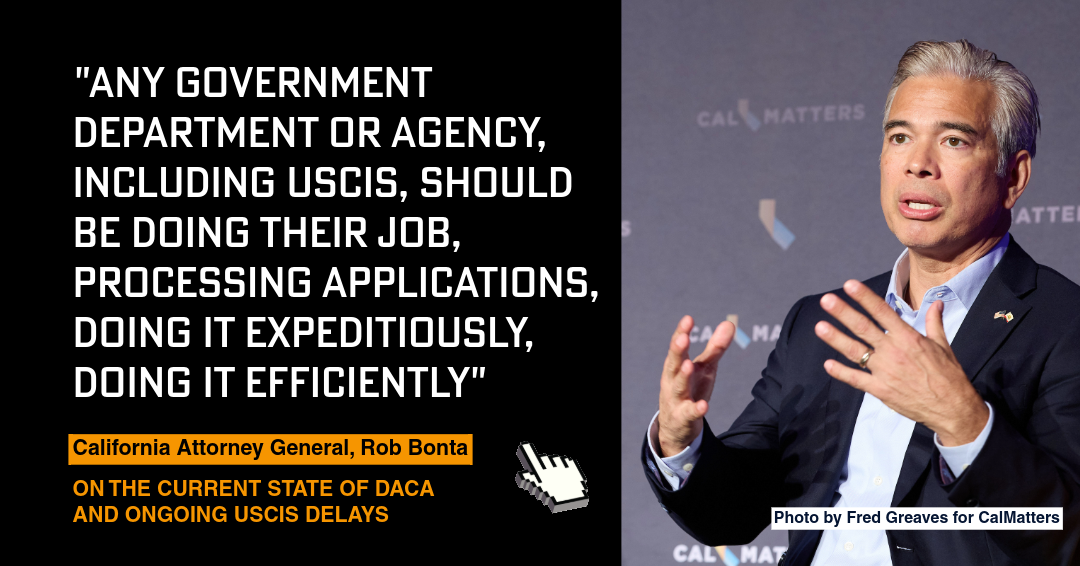
California's Attorney General, Rob Bonta, was generous enough to lend me a few minutes of his time at CalMatters' Ideas Festival, where he was set to appear alongside former DHS Secretary Janet Napolitano — who oversaw the rollout of DACA during the Obama Administration. On the Trump Administration's ongoing delays in processing DACA renewals, Bonta didn't mince words: "death by a thousand cuts," he called it. He shared how his office defended DACA all the way to the U.S. Supreme Court during Trump's first term, how his own immigrant story inspires him to keep going, and made clear he intends to keep fighting on behalf of DACA recipients. "We will continue to fight for Dreamers," he told me, "who really know no other country except for this one."
Speaking of DACA, the Trump Administration continues to delay processing of renewal applications for the Obama-era program, which protects eligible immigrants from deportation while allowing them the opportunity to work and drive legally across the country. The arrest of a prominent DACA recipient in Tucson, AZ recently generated national headlines and prompted questions from Congresswoman Adelita Grijalva. Be sure to read this incredible piece from NPR about the state of the DACA program.
Elsewhere on immigration: the Associated Press reports on a spike in suicides by ICE detainees... DHS Secretary Mullin floats a plan to punish local economies and cities that rebuke ICE operations... Brookings reports that more than 100,000 children have been separated from their parents by the Trump Administration... and emissions from ICE enforcement flights went up 88% between 2024 and 2025.
ON THE FUTURE OF THE WEB: I recently spent time listening to The Vergecast — a podcast about tech — where Nilay Patel and David Pierce from The Verge broke down the updates coming out of Google's annual developers conference. A lot of it has to do with new AI models, AI agents, and Google's vision for further embedding AI into every corner of its ecosystem. But Patel's and Pierce's take on Google Zero — a practice where Google keeps traffic within its own platform without pushing users to outside sources — is what gave me pause.
In short, Google Zero has the potential to radically change how we interact with search engines and the web as a whole.
The familiar list of links Google serves you when you search for something would be gone, replaced with AI-generated results tailored just to you — making it harder to find objective information and nudging you to spend more time inside Google's algorithm and, in Google's vision, buying more stuff.
Scroll to minute 24 and have a listen to how Google is done asking for permission when it comes to reshaping (or eliminating) some of the most familiar aspects of the Internet as we have come to know them.
CLOSING THOUGH: Stars Wars
🚀🚀🚀
I caught The Mandalorian and Grogu on IMAX this weekend. Here's where I landed: If the movie flops financially, it's because the people in charge (Disney) made a choice.
Did The Mandalorian have to be turned into a movie? No.
Could it have easily been a season of the TV show? Yes.
It's exactly what it is — great action and Star Wars fun without much weighing it down. A movie for kids fans, not for critics.
However, if the numbers don't add up and the studio has to cancel other projects because of it, they'd be punishing the fan base for their own decisions. That's not on the fans.